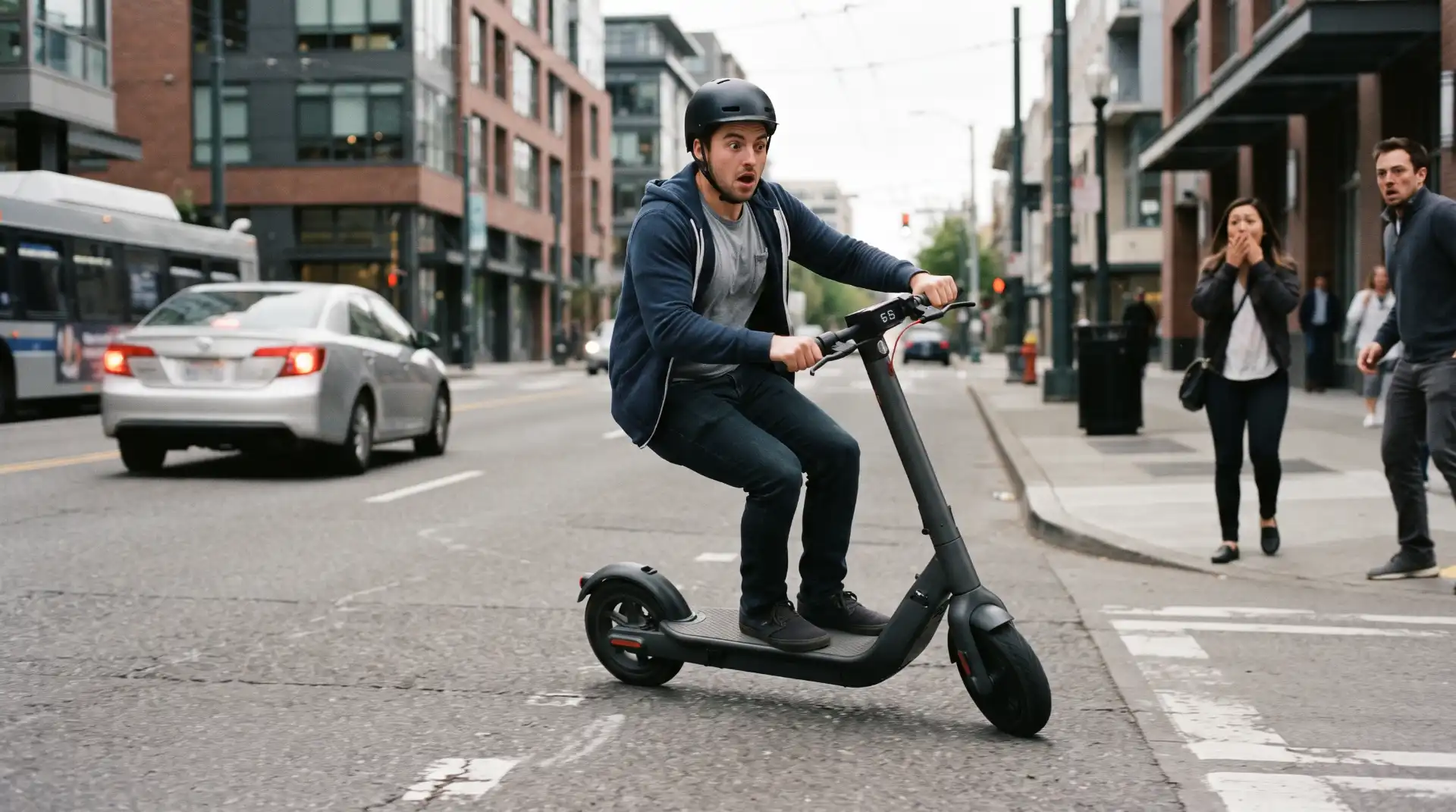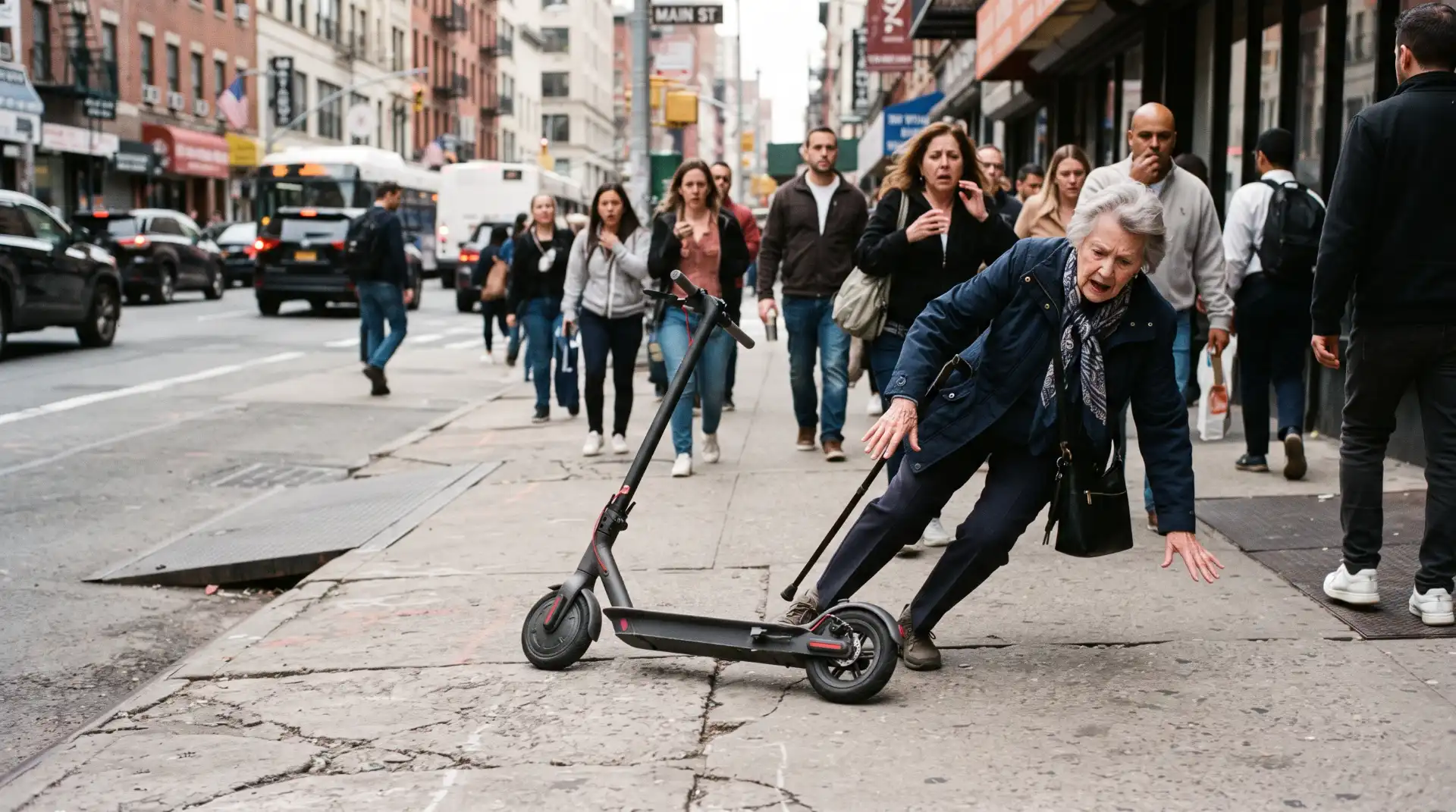
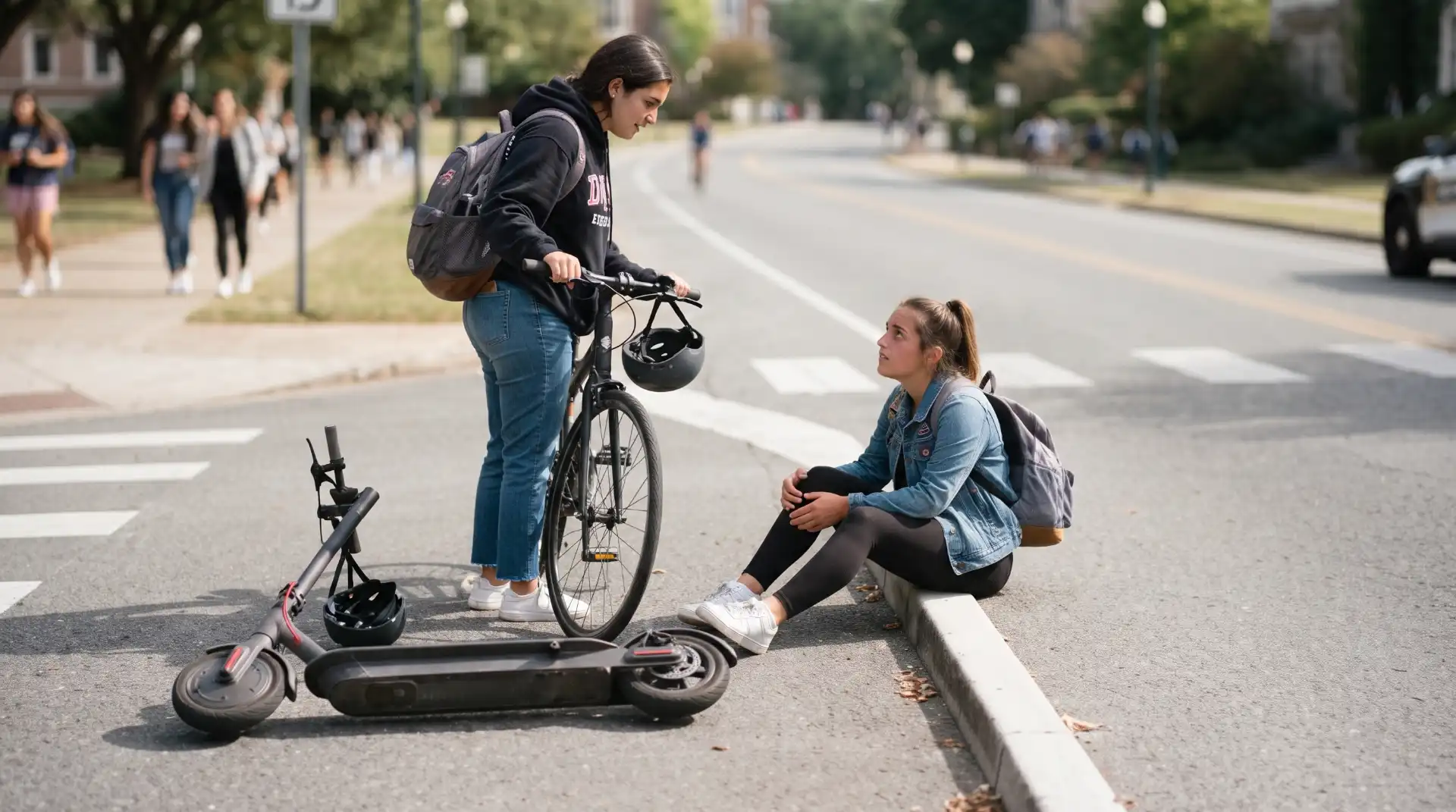
Electric scooters have become a familiar part of transportation on American college campuses. Students use personal and shared e-scooters to travel between residence halls, classrooms, libraries, parking areas, restaurants, and nearby neighborhoods. Their convenience is obvious, especially on large campuses where walking from one end to another can take considerable time. However, greater scooter use has also introduced difficult questions about accidents, responsibility, and insurance coverage.
An e-scooter accident on a college campus can involve far more than two people. Depending on how the collision occurred, responsibility might involve a motorist, another scooter rider, the university, a government entity, a rental scooter company, a property owner, or even a manufacturer. Insurance can be equally complicated because policies designed for automobiles, homeowners, renters, and health care do not necessarily treat electric scooters in the same way.
The problem is becoming increasingly relevant nationwide. The U.S. Consumer Product Safety Commission has documented substantial growth in injuries associated with micromobility products, including electric scooters. According to the CPSC’s 2026 micromobility report, an estimated 79,300 emergency-department-treated injuries were associated with e-scooters in 2024.
For students, parents, motorists, and other campus visitors, understanding how liability may be determined can make the aftermath of a scooter crash easier to navigate.
Why E-Scooter Accidents Are Different on College Campuses
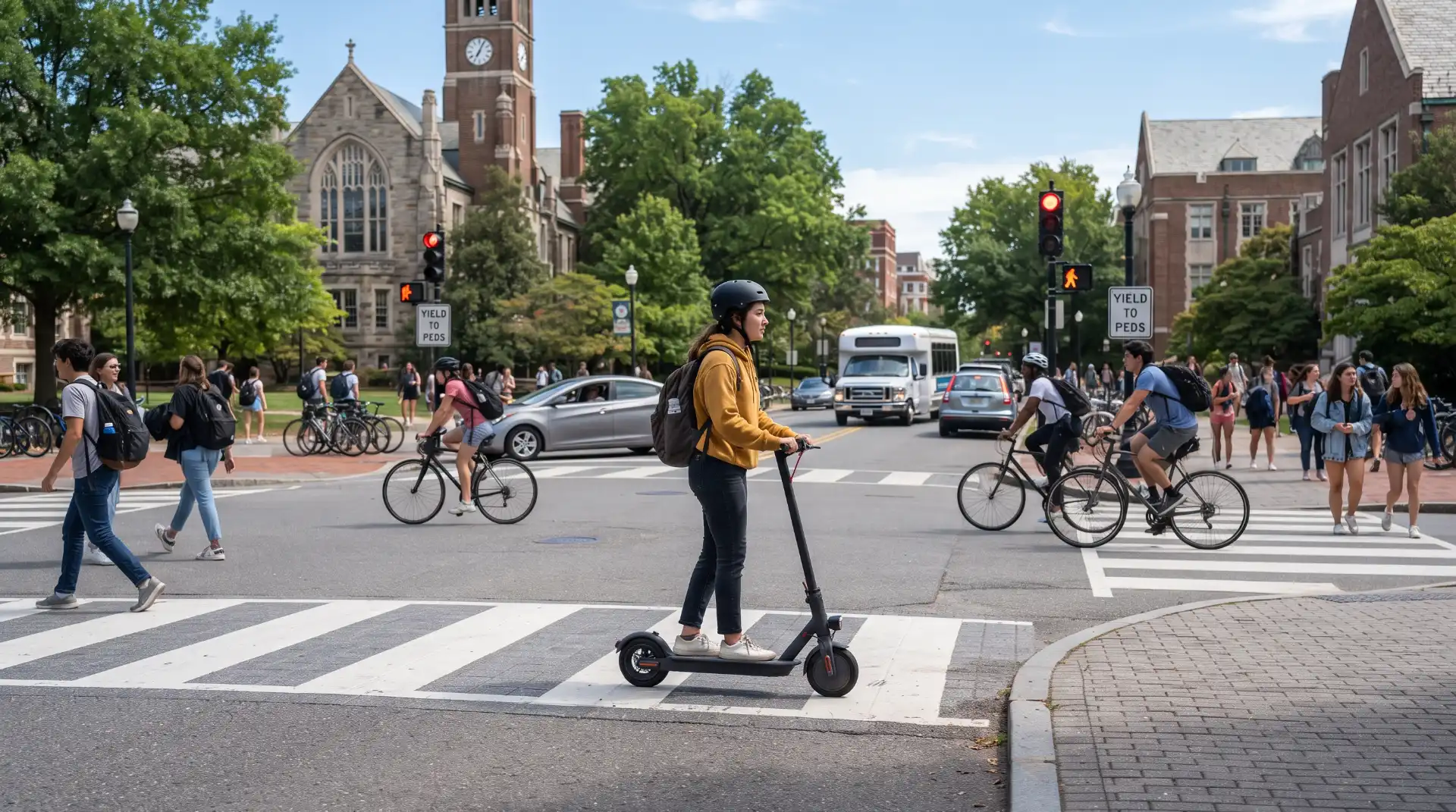
A university campus is not quite a traditional city street and not quite private residential property. A single campus may contain public streets, university-owned roads, private parking garages, pedestrian plazas, bike lanes, sidewalks, service roads, residence halls, and areas controlled by outside contractors.
That mix can make determining responsibility difficult.
A student could be struck by a vehicle on a public street running through campus. Another rider might collide with the student on a university-owned path. A rental scooter could malfunction because of a maintenance problem. An accident might also happen because of a pothole, poor lighting, construction debris, an obstructed sign, or an unsafe intersection design.
Each scenario can lead to a different liability analysis.
Campus transportation also changes throughout the day. Roads that appear quiet early in the morning may become crowded between classes. Pedestrians may suddenly enter scooter paths. Delivery vehicles, university buses, bicycles, rideshare vehicles, maintenance trucks, and scooters can all converge in the same limited space.
These conditions can make seemingly simple crashes surprisingly complex.
Who May Be Liable for a College Campus Scooter Accident?
Liability generally depends on what caused the accident and whether someone’s negligent conduct contributed to it. In many cases, more than one party may share responsibility.
A Negligent Motor Vehicle Driver
Drivers remain one of the most obvious potential sources of liability when a scooter rider is hit by a car, truck, rideshare vehicle, delivery van, or other motor vehicle.
A driver may potentially be responsible if the evidence shows that the driver failed to use reasonable care. Examples can include speeding, failing to yield, making an unsafe turn, running a traffic signal, driving while distracted, opening a vehicle door into the rider’s path, or entering a bicycle lane without checking for approaching traffic.
Campus environments can increase these risks because drivers may be unfamiliar with university roads or distracted while searching for parking, residence halls, or passenger pickup areas.
When a motor vehicle is involved, the driver’s automobile liability insurance may become an important potential source of coverage. Riders dealing with this type of collision may also find the site’s guide on handling a scooter-versus-car accident claim useful for understanding the basic claims process.
Another Scooter Rider or Cyclist
Not every scooter accident involves a car. Two riders can collide with each other, or a scooter rider may be struck by a cyclist using the same lane or pathway.
Liability in these situations can depend on factors such as speed, right of way, passing behavior, visibility, adherence to campus rules, and whether either person was distracted or impaired.
Insurance questions become more difficult because scooter riders and cyclists generally do not carry the same mandatory liability coverage that motorists typically must maintain. A homeowners or renters insurance policy might provide personal liability protection in certain circumstances, but coverage depends heavily on the policy language and exclusions.
The College or University
A university may sometimes become part of the liability analysis when an accident involves property or infrastructure it controls. Examples might include dangerous pavement defects, poorly maintained pathways, inadequate lighting, missing warnings, hazardous construction areas, or other conditions that the institution knew or reasonably should have known about.
However, proving that a dangerous condition existed is not enough by itself in every case. Questions may include who actually controlled the location, whether the institution had notice of the hazard, whether there was a reasonable opportunity to correct it, and whether the condition substantially contributed to the accident.
The legal rules can also differ significantly between public and private universities.
Public Universities Can Raise Government Liability Issues
Many public universities are part of state governmental systems. Claims involving a state university can therefore be subject to laws that do not apply to an ordinary private property owner.
Depending on the state, governmental immunity may limit certain claims or impose special procedural requirements. A person may also have to submit an administrative notice or governmental claim before filing a lawsuit. Those deadlines can be considerably shorter than the normal statute of limitations for a personal injury action.
Because these requirements vary widely across the United States, students should not assume that the ordinary deadline for an injury lawsuit automatically applies to an incident involving a public university.
Private Colleges and Universities
A private college generally does not receive the same governmental protections that may apply to a public institution. However, that does not make the school automatically responsible whenever someone is injured on campus.
A negligence or premises liability claim typically still requires evidence connecting the institution’s conduct or a dangerous property condition to the injury.
For example, a school might face questions about maintenance if a scooter rider crashes because of a large pavement defect that had reportedly existed for months. The analysis could be different if the defect appeared only moments before the accident and the university had no reasonable opportunity to discover it.
Can a Rental Scooter Company Be Responsible?
Shared scooter companies are common around universities because students frequently need transportation for short trips. A rider may unlock a scooter through an app, ride it for several minutes, and leave it at another approved location.
When a rental scooter is involved in a crash, investigators may need to determine whether the accident resulted from rider behavior or a problem with the scooter itself.
Possible equipment-related issues include faulty brakes, throttle problems, steering defects, damaged tires, loose components, electrical faults, or structural failures.
If the scooter had a known maintenance problem and remained available for rental, responsibility could potentially extend beyond the rider. The circumstances may involve the rental operator, a maintenance contractor, distributor, or manufacturer.
Mechanical failures deserve particular attention because the rider may have little warning before losing control. Readers interested in this issue can also review the site’s detailed explanation of e-scooter brake failure.
Rental agreements can complicate matters further. Scooter apps commonly contain contracts addressing assumption of risk, liability, dispute procedures, and other legal conditions. The effect and enforceability of those provisions depend on applicable law and the specific agreement.
What If the Scooter Itself Is Defective?
Some accidents are caused not by traffic conditions but by the product itself. A defective electric scooter may create potential product liability questions involving the manufacturer, distributor, or another party in the supply chain.
Potential defects may involve design, manufacturing, software, batteries, steering systems, folding mechanisms, tires, or braking components.
This is not merely theoretical. The U.S. Consumer Product Safety Commission’s micromobility safety resources include recalls involving electric scooters and related products because of fall, crash, fire, and injury hazards.
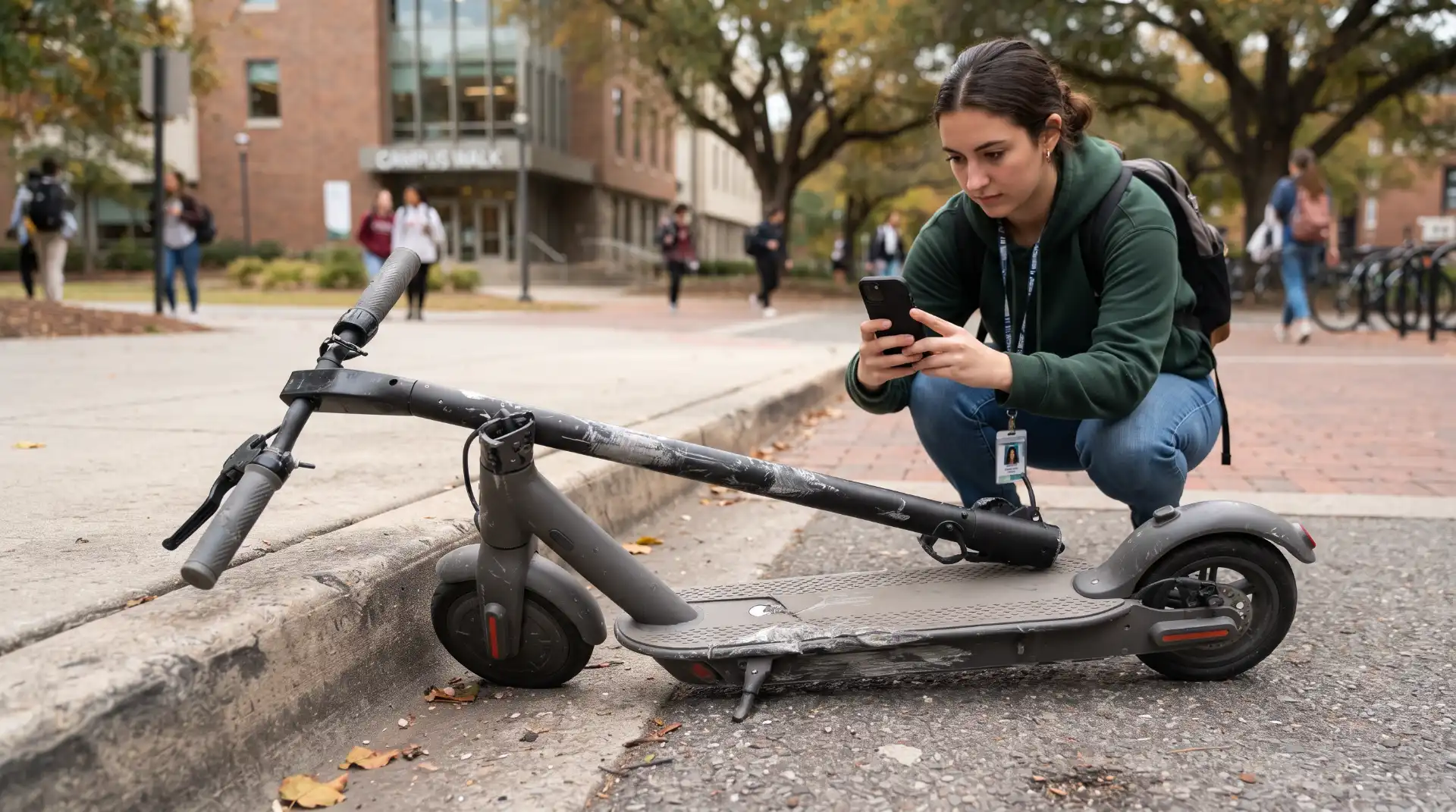
When a mechanical problem is suspected, preserving the scooter can be especially important. Repairing, discarding, returning, or modifying the device before it is examined could eliminate evidence about why it failed.
Dangerous Campus Roads and Pathways
Road conditions are another recurring issue in scooter crashes. Electric scooters have relatively small wheels, meaning pavement problems that barely affect a passenger car can destabilize a scooter.
Potholes, cracked pavement, utility covers, loose gravel, construction materials, poorly designed drainage grates, sudden surface changes, and debris can all contribute to loss of control.
Determining who is responsible requires identifying who controlled the property. A road running through the middle of a university may actually belong to a city or state. A sidewalk could be maintained by the school, municipality, landlord, or another entity. Construction zones might involve independent contractors.
That distinction matters because the party responsible for maintenance is not always obvious from the accident scene.
How Comparative Fault Can Affect a Scooter Accident Claim
Responsibility does not always fall entirely on one person. Many states use some form of comparative negligence when multiple parties contribute to an accident.
Consider a student riding an e-scooter through campus while looking at a phone. At the same time, a driver makes an unsafe turn and strikes the scooter. Evidence might show that both the motorist and rider contributed to the collision.
How that shared responsibility affects compensation depends on the law of the state where the accident occurred. Some jurisdictions allow recovery even when the injured person bears substantial responsibility, while others restrict recovery once the person’s share of fault reaches a particular threshold.
This is one reason a campus scooter claim should not be evaluated solely from the fact that the rider received a citation or may have made a mistake. The conduct of everyone involved should be examined.
What Insurance Pays After a Campus E-Scooter Accident?
Insurance is often one of the most confusing parts of an electric scooter accident because no single policy applies to every situation.
The National Association of Insurance Commissioners has cautioned consumers that scooter-sharing accidents can create coverage gaps and that traditional home and auto policies may not necessarily cover scooter use. Policyholders should therefore examine their actual contracts rather than assuming that a familiar insurance policy automatically applies.
The Driver’s Auto Liability Insurance
If a motorist negligently strikes a scooter rider, the driver’s auto liability insurance may potentially cover bodily injury damages up to the available policy limits, subject to state law and policy terms.
The insurer may investigate police reports, witness statements, photographs, video footage, vehicle damage, medical records, and other evidence before accepting or disputing liability.
The Rider’s Health Insurance
Health insurance may help pay medical expenses after an accident regardless of who eventually proves responsible. Deductibles, copayments, network restrictions, reimbursement rights, and other policy rules may still apply.
Using health insurance generally does not determine who was legally at fault for the accident. Liability claims and medical insurance benefits address different issues.
Uninsured and Underinsured Motorist Coverage
Students sometimes assume that their own automobile uninsured or underinsured motorist coverage will automatically protect them if they are hit while riding a scooter. That is not always the case.
Coverage depends on the policy wording, state insurance law, how the scooter is classified, and the circumstances of the crash. Some policies may provide protection in certain situations, while exclusions or definitions can limit it in others.
Reviewing the actual policy is more reliable than making assumptions based on the policy’s name.
Renters or Homeowners Insurance
College students may be covered under their own renters policy or, in some circumstances, under a parent’s homeowners policy. Personal liability coverage can sometimes become relevant if a student is accused of injuring someone else.
However, policies commonly contain exclusions involving motorized vehicles. Whether an electric scooter falls within an exclusion can depend on definitions, exceptions, location of the incident, power, ownership, and other policy provisions.
The National Association of Insurance Commissioners specifically recommends that scooter users speak with their insurer or agent about coverage rather than assuming a home or auto policy applies.
Rental Scooter Company Insurance
A scooter company’s insurance should not automatically be treated as protection for every rider. Coverage can vary substantially between companies and jurisdictions.
The rental agreement may explain whether any insurance is provided, what limits apply, and what events are excluded. Some contracts may place much of the financial risk on the user.
Students who frequently use shared scooters may benefit from reviewing these terms before an accident occurs rather than discovering a coverage limitation afterward.
University Insurance
A college may carry commercial, governmental, property, or liability insurance for risks associated with its operations. That does not mean the school’s insurance automatically covers a student’s scooter accident.
University insurance generally protects the institution against covered claims rather than functioning as personal accident insurance for everyone on campus.
Whether university coverage becomes relevant depends on whether the school bears legal responsibility for the incident.
Campus Security Cameras Can Become Important Evidence
College campuses often contain more cameras than ordinary residential streets. Residence halls, parking structures, libraries, campus entrances, athletic facilities, dining areas, and intersections may be monitored by security systems.
This footage can provide valuable evidence about how a scooter collision occurred. It may show traffic signal timing, vehicle movements, rider behavior, the condition of a pathway, or how long a dangerous condition existed.
However, surveillance recordings may not be stored indefinitely. Depending on the institution’s retention system, footage could eventually be overwritten.
Nearby businesses, apartment buildings, public buses, rideshare vehicles, and private vehicles may also have cameras capable of recording the incident.
Other Evidence That Can Matter
Electronic scooter accidents can generate forms of evidence that do not exist in traditional pedestrian accidents.
A rental company’s app may contain trip start and end times, scooter identification information, payment history, GPS data, and records associated with the device. Maintenance databases may indicate whether the scooter had recently been inspected or reported as defective.
Other useful evidence can include photographs, witness contact information, campus police reports, municipal police reports, medical documentation, damaged clothing, the scooter itself, nearby camera footage, and communications with the rental operator.
Students unfamiliar with the immediate steps following an injury can review the site’s step-by-step guide for what to do after a scooter accident.
Delivery and Rideshare Traffic Can Add Another Layer
Modern college campuses receive constant traffic from food delivery drivers, grocery services, package couriers, and rideshare vehicles. Drivers may stop suddenly near residence halls, enter bicycle lanes, make frequent U-turns, or concentrate on navigation apps while searching for customers.
If a commercial or app-based driver causes a scooter accident, determining insurance coverage can require investigating what the driver was doing at the exact time of the collision.
For app-based work, insurance coverage may differ depending on whether the driver was logged into an application, waiting for a request, traveling to a pickup, or actively completing a delivery or passenger trip.
The site’s article on delivery driver versus scooter accident claims provides additional information about this increasingly common collision scenario.
Do Campus Scooter Rules Affect Liability?
Many universities adopt their own micromobility policies. A school might establish speed limits, designated parking areas, restricted pedestrian zones, helmet requirements, no-ride zones, or rules limiting where scooters may be charged and stored.
These policies can be relevant evidence after an accident, but violating a campus rule does not necessarily resolve legal liability by itself.
State traffic statutes, municipal ordinances, university regulations, property rules, and general negligence principles may all interact. Campus regulations also vary considerably between institutions.
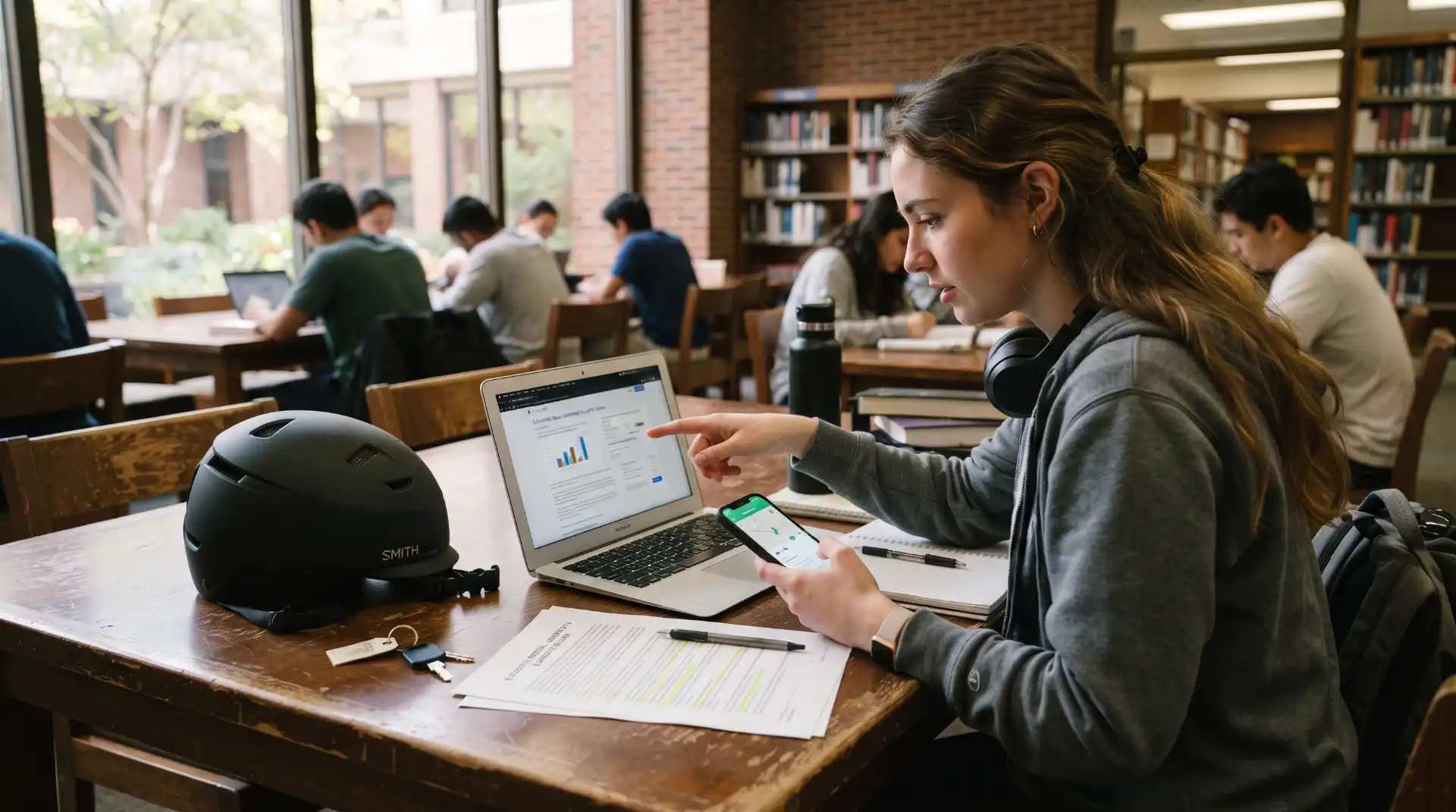
Students who regularly ride should check the transportation or public safety section of their own university’s website for current rules instead of assuming that regulations from another school apply.
Why Helmet Use Still Matters
Regardless of who may ultimately be liable, helmet use remains an important injury-prevention measure. Scooter riders have little physical protection in a collision, and their bodies can be thrown directly onto pavement or into a vehicle.
The CPSC recommends helmet use and other precautions when riding micromobility devices. Its safety materials also emphasize checking products for damage, following manufacturer instructions, and using appropriate charging equipment.
Helmet requirements differ by state, locality, age, and sometimes campus policy. Riders should therefore review applicable rules where they attend school.
What to Do After an E-Scooter Accident on Campus
The immediate aftermath of a crash can affect both health and the ability to determine what occurred. A rider should first address medical needs and emergency safety. Serious symptoms warrant emergency assistance.
When circumstances permit, documenting the scene can also be useful. Photographs can capture the scooter, roadway, vehicles, signs, lighting, pavement conditions, and surrounding area before anything changes. Witness names and contact information may help if accounts of the accident later conflict.
Campus police, security personnel, or local law enforcement may also need to be notified depending on the location and severity of the crash.
If a rental scooter is involved, preserving the scooter number and trip information can make it easier to identify the exact device later. A mechanical problem should be documented before the equipment disappears back into a shared fleet.
Why Identifying the Property Owner Matters Early
One overlooked issue in campus crashes is determining who actually owns and maintains the location where the accident happened.
A roadway that appears to be part of campus might belong to the city. A parking structure could be operated by a private company. Student housing may be privately owned even though it sits next to university property. A construction project might temporarily place maintenance responsibility on a contractor.
Identifying the correct party becomes especially important when special notice deadlines apply to government entities.
Maps, maintenance agreements, public property records, university transportation documents, and contracts may eventually help clarify control of the location.
College Students Should Not Assume Insurance Coverage Exists
Perhaps the most important insurance lesson is that an e-scooter sits in an unusual position between pedestrian transportation, bicycles, and motor vehicles.
A student may have health insurance, renters insurance, access to a parent’s homeowners policy, or even an automobile policy and still encounter gaps after an electric scooter crash.
The existence of insurance does not guarantee that a particular loss is covered. Definitions and exclusions matter.
Before regularly using a personal or shared scooter, riders can ask their insurance company whether their policies provide liability protection for injuries they cause, coverage for injuries caused by uninsured motorists, or protection for damage to the scooter itself.
Those questions are much easier to resolve before an accident than afterward.
The Bottom Line on Campus E-Scooter Liability
E-scooters fit naturally into college life, but the legal and insurance issues surrounding them are still more complicated than many riders expect. A single campus crash may involve a negligent driver, another rider, university property, a municipality, a scooter rental company, a defective product, or several of those factors at the same time.
Insurance coverage can be equally fragmented. Automobile liability insurance may apply when a motor vehicle causes the accident, health insurance may address medical treatment, and other policies may or may not provide additional protection depending on their terms.
The most important point is that no nationwide rule makes every college scooter accident the same. State law, campus ownership, local ordinances, insurance contracts, rental agreements, and the specific facts of the collision all matter.
As electric scooters continue to become part of everyday transportation at American universities, students and other road users should understand both the convenience and the risks that come with them. Knowing campus rules, checking insurance coverage, preserving evidence after a crash, and identifying everyone who may have contributed to the accident can provide a clearer picture of what options may be available afterward.